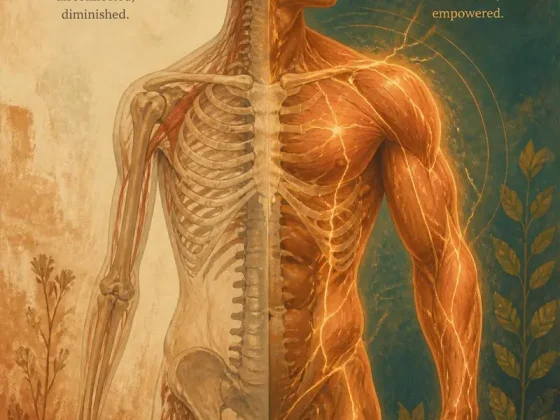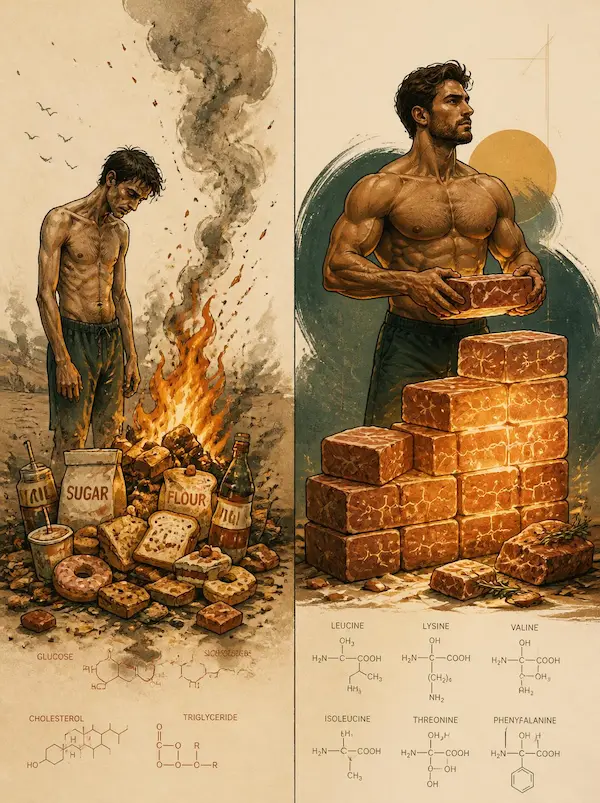
The equation official nutrition missed – and why it costs entire lifetimes. What can I say, We all fell for it. So what is the 50-years lie in nutrition?
It was all about Essential Amino Acids, not about sugars and fat
by Bralgei Shackry | bralgei.com | 30+ years of experience in nutrition, biohacking, and cellular regeneration
Read this before the article.
This thesis is about the trick or trap in nutrition and medicine that we have been in for many years, decades. Considering that we have 3 main classes of nutrients that we can use (sugars/carbohydrates – fats/fatty acids – amino acids/proteins), the main trick is that what we eat reaches the cells. FALSE.
I stepped out of the forest, and saw the whole picture. And it isn’t what I thought.
You have counted calories for 50 years. For 50 years you have listened to the “sugar or fat, which one is the enemy” debate. You have tried low-carb. You have tried keto. You have tried low-fat. You have counted, weighed, calculated – and your body still never responded the way it should.
It’s not your fault. It’s the fault of a broken concept that got handed to you, because that’s all anyone could manage at the time.
Thank you to everyone who dedicated themselves to the details – the researchers, the nutritionists, everyone who spent an entire career measuring one macronutrient or another. But we need to look at reality from the right position: that of the people who actually use these bodies, and who need to know what to do, as managers of their own body. We don’t have another one. So let’s do right by it and learn what it needs, so we can give it that – if we want it to regenerate.
As usual, everything is backwards, or we’re pushed to look in a direction other than the one that actually matters.
THE SECRET IS IN AMINO ACIDS. Period.
These 3 classes of nutrients must be transformed, methylated and this is a process that we have to go through very scientifically, syncretically and explained in simple terms but supported by serious science.
But this is not the biggest hoax. The thesis we are approaching is much more sensitive and involves something that has not been done before.
It is so sensitive that the initial reaction will be one of rejection. It’s about the fact that essentially sugars and carbohydrates are only sources of fuel, co-factors and support for the real work of cells – that is, for the use of amino acids. Each element is important but if you are alive it means that the body has managed in one way or another to have the necessary energy and the necessary basic resources, at least to keep you alive at some point.
But how well you are biologically does not depend, for the most part, on these two – because neither of them turns into peptides, into simple or complex amino acids, into neurotransmitters, into enzymes, or into the proteins that maintain and repair this body. (Fat is a partial exception – it participates in membranes and steroid hormones – but even fat never becomes an enzyme or a protein.) Regardless of whether we are talking about the micro or macro level.
Starting from the rotating nanometric motors of mitochondria to the most complex synthesis mechanisms or neurons, all these sub-assemblies coordinated by basic generic programs (DNA/RNA) and up to the coordination given by consciousness, all depend on a source of energy, precise controls and building materials of the highest quality (plus water, hydrogen, oxygen, minerals, etc but this is known).
I want you to understand that the big picture I’m presenting is that in the absence of the basics, the cells and the body struggle to keep you alive, constantly struggle with fire (inflammation and its co-effects), struggle with the lack of real resources that can be used at the cellular level, and struggle with the elimination of waste and toxins.
Sugar and fat are, for the most part, FUEL. That’s it. They burn, they produce energy, and they disappear. Yes, fat also builds membranes and steroid hormones – but neither of them ever becomes an enzyme, a neurotransmitter, or a protein. Your body isn’t built, in its active essence, from calories – it’s built from amino acids. And if you don’t have enough of them, in the right quantity and quality, everything else is just fire with no building materials.
“That’s the 50-year lie: we counted the fuel and ignored the bricks.”
— Bralgei Shackry
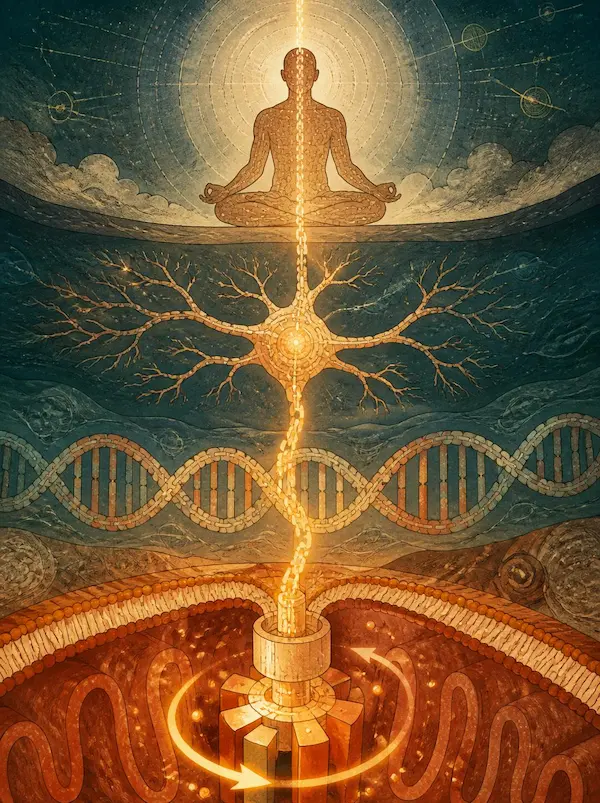
Part One: the story behind the equation – and how I learned it the hard way.
For thirty years I didn’t eat meat.
I’m not telling you this to convince you to do the same. I’m telling you for what I learned from it – because thirty years is long enough to find out what you’re allowed, and what you’re never, ever allowed, to do with your body. That’s assuming you don’t cheat and you actually develop body awareness, if you listen to it. Body Awareness – that’s my secret. I didn’t read it in a book. I built it, year after year, listening to what my body told me when I got it wrong.
I was never “pure, hardcore vegan, full stop.” I always compensated, in well-structured cycles – Spirulina for a while, a bit of fish for a while, high-dose vitamin C, omega-3 from sources that don’t oxidize. Not because “that’s how it’s done,” but because I listened to my body and saw clearly: you can afford to restrict something for a while – if you know exactly what you’re restricting and why – but you can’t restrict forever without giving back, in cycles, exactly what you took out.
The secret isn’t restriction. It’s the CYCLE. The secret is having cycles where you give, one at a time, exactly what the body needs, at the right moment – not everything at once, not nothing ever.
SCIENTIFIC CONFIRMATION
I’m not just speaking from personal experience. Here I’m drawing a parallel, not claiming that science has proven exactly what I’m saying about nutrition – but the parallel feels too fitting to ignore. David Sinclair’s team at Harvard demonstrated, with published data (on mouse retinal ganglion cells, not on nutrition), that regeneration doesn’t require a full reset: 3 of the 4 Yamanaka factors (OSK – Oct4, Sox2, Klf4), without the fourth (c-Myc, which erases too much and leads toward cancer), restored visual function while keeping the cell’s identity intact. It isn’t a study about diets or eating cycles – it’s a study about partial cellular reprogramming. But the underlying principle – controlled regeneration, with precise limits, not a total wipe – is exactly the logic I apply myself, empirically, across 30 years of dietary cycles.
Sources: Lu et al., Nature, 2020 (Sinclair team, Harvard Medical School); Life Biosciences, primate data, ARVO 2023.
Not a total wipe. Not infinite regeneration with no brake. A cycle, controlled, with precise limits. The same law applies at large scale, not just in the lab: acceleration AND braking, at the same time. Never one without the other.
And that’s exactly why I look with attention and respect – not spite, attention – at stories like Bryan Johnson’s. At least he tried, and that’s why I respect him. The people who never tried don’t count, as far as I’m concerned. They never stepped into the arena, they never failed.
Bryan is a man with nearly unlimited resources, a strictly plant-based diet kept rigid, with no cycles, plus near-total sun avoidance – and who recently announced, publicly, an autoimmune condition. I don’t know exactly what caused it, and probably neither does he, with his whole army of doctors. But the observation stands: restriction with no cycle, pushed to the extreme, no matter how “optimized” on paper, still finds a crack where the body tells you something.
Your body doesn’t want either extreme from you. It wants what it needs, when it needs it, in the right cycle. And what it needs, almost always, isn’t what you think.
Life has a golden zone where it works. The principle is simple, even if it sounds philosophical: anything outside that golden band drifts toward death or dysfunction. That’s why I see things in flux, not fixed extremes – and that’s why everything in this article circles back to the same idea: it’s not the maximum or minimum amount that matters, it’s what you give, to what, and when.
Part Two: the 50-year lie – why “a calorie is a calorie” is a 127-year-old wrong story.
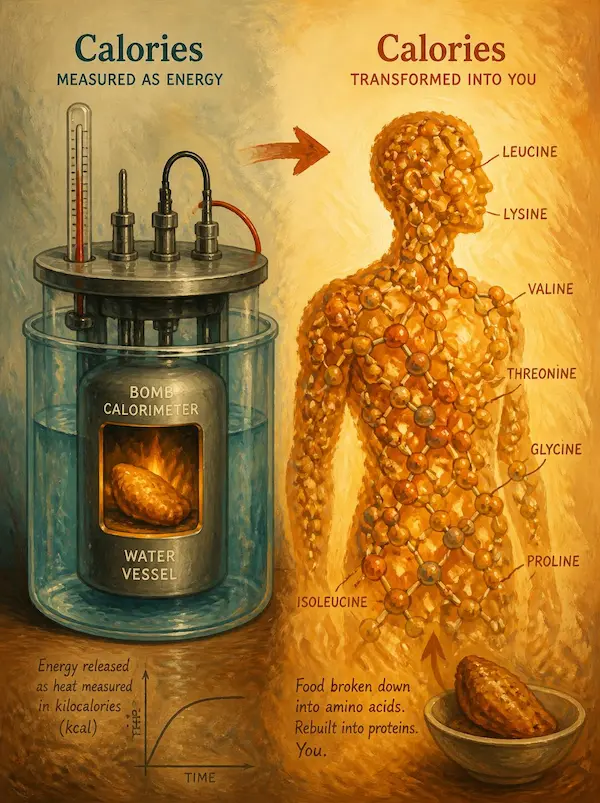
Do you know where the number on your food label actually comes from? Not from a lab that studied WHAT that food does inside your body. It comes from a container of water.
In the late 1800s, chemist Wilbur Atwater burned thousands of foods in a bomb calorimeter – a sealed vessel, submerged in water, in which food is literally incinerated down to ash. He measured how many degrees the water’s temperature rose. Then he subtracted the energy found in the feces of people who’d eaten the same foods. The difference became the “Atwater values” – the 4 kcal/g figures for carbohydrates and protein, 9 kcal/g for fat, that you still see today, unchanged for 127 years, on every label in the world.
A calorie is NOT a calorie. And I’m not the first to say it – the scientific community itself has been saying it, for over 20 years, in an article with that exact title.
SCIENTIFIC CONFIRMATION
In a landmark article in Nutrition Journal, researchers Eugene Fine and Richard Feinman show that the “a calorie is a calorie” principle – the idea that weight loss depends only on how many calories go in, regardless of source – violates the second law of thermodynamics when applied to the human body. Another study, published in the Journal of the International Society of Sports Nutrition, puts it even more directly: different diets lead to different biochemical pathways, which are not equivalent when correctly compared through the laws of thermodynamics – biologically speaking, a calorie categorically is not a calorie.
It’s not just theory. The body spends energy differently to process each type of fuel – the phenomenon is called the thermic effect of feeding (TEF). Diets rich in carbohydrates or fat produce only a 4-8% increase in energy expenditure after a meal. Protein-rich meals produce an 11-14% increase over basal metabolic rate – the body actually burns off part of protein’s own calories just to break it down, because it isn’t simple fuel, it’s material that has to be carefully disassembled, amino acid by amino acid, not burned in bulk.
A clinical study on lean and obese subjects showed something even more unsettling: in obese subjects, fat ingestion produced almost no increase in metabolic rate – unlike lean subjects, where the increase was significant. The same “fuel,” the same calories on paper – completely different reactions, depending on the person’s metabolic state.
Sources: Fine & Feinman, Nutrition Journal, 2004; Journal of the International Society of Sports Nutrition, Manninen, 2004; comparative TEF study, American Journal of Clinical Nutrition, 1985.
The NUMBER on the label doesn’t tell you what food does inside you. It only tells you how hard it burns in a container of water, 127 years ago, at Wesleyan University.
“You counted calories for 50 years just to finally find out the count was wrong from the very first number. The fuel was never the problem. The fuel’s accounting was the problem.”
— BRALGEI SHACKRY
But here’s the part you haven’t seen yet, and it changes the rest of the conversation: if counting calories isn’t the real problem, but the missing building material behind them – then why, exactly, do you overeat? The answer has a name in serious scientific literature, and nobody’s told you yet. We’ll get there. But first, let’s see exactly where every bite you eat actually goes.
Part Three: the 3 pathways – from your plate to your cell.
You think you eat food. But reality is bigger than that: it doesn’t matter what you eat. What matters is what reaches the cell. Your cells eat something different from what you put in your mouth. You just carry the material to the door – the rest is a production line with thousands of steps, one you never see or feel, but one that decides whether you live well or just survive.
-> On the eating window and why hunger is the most powerful tool you have, for free: “Nothing Beats Hunger”.
Let’s follow each pathway, all the way to the end, so you see exactly where each one leads.
The sugar pathway: a fast dead end
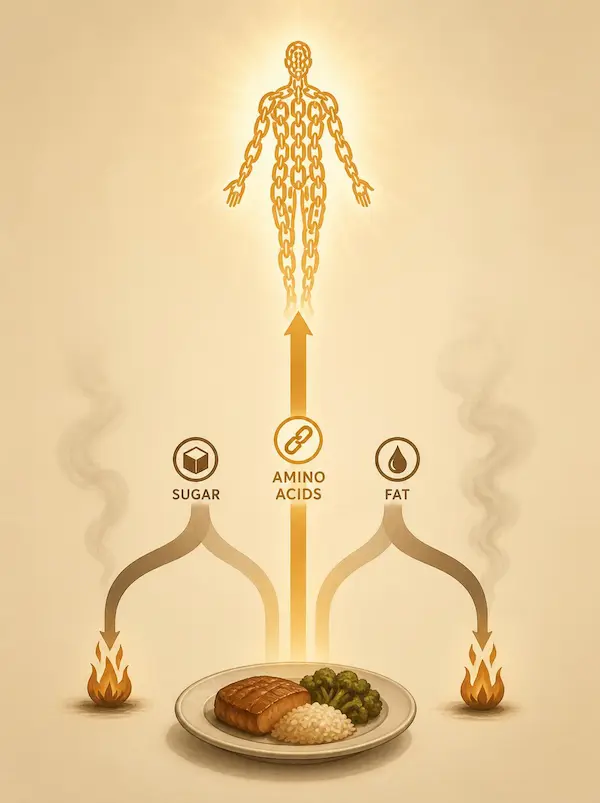
Starch and sugar become glucose through enzymatic digestion. Glucose enters the blood, insulin pushes it into the cell. In the cytoplasm, glycolysis turns it into pyruvate – ten enzymatic steps, a modest profit of 2 ATP. Pyruvate then has two roads: it enters the mitochondria, becomes Acetyl-CoA, feeds the Krebs cycle and the electron transport chain – that’s where the real energy comes out, ~30 ATP per glucose molecule – or, lacking oxygen, it becomes lactate, fast and limited energy, good for a sprint, not for a life.
And now hold onto this: no matter which road it takes, the end of the line is always the same – CO2, water, energy, or fat storage if there’s too much. Never an enzyme. Never a neurotransmitter. Never a new cell.
The fat pathway: the same dead end, with a few bonuses
Triglycerides become fatty acids and glycerol. Fatty acids enter beta-oxidation, in the mitochondria, and come out piece by piece as Acetyl-CoA – same entry into Krebs, same output as energy. In fasting or ketosis, the liver turns the surplus Acetyl-CoA into ketone bodies, an alternative fuel for the brain. Fat also has real roles beyond burning – it’s a precursor for steroid hormones (cholesterol becomes testosterone, cortisol), it’s a structural membrane component, it’s a signaling molecule for inflammation. But even so, it never becomes active machinery. It’s a passive brick in the wall, or a regulator – not an engine, not a worker.
The amino acid pathway: the only one that climbs toward structure
Protein becomes peptides, then free amino acids, via pepsin, trypsin, chymotrypsin, and peptidases.
Here’s a correction I need to make, right from the start: 100g of meat or egg doesn’t mean 100g of protein. Cooked meat contains, on average, 25-31g of protein per 100g (the rest is water and fat, in proportions that vary by the type of meat); a whole egg has ~13g of protein per 100g. So the first thing to keep in mind is that only part of the food’s mass is actual building material – the rest (water, fat) doesn’t enter the amino acid calculation at all.
From that percentage of protein, amino acids then pass through 2 filters before they become available to the muscle. The first filter – digestion – is very efficient in a healthy person: 86-92% of amino acids cross the intestinal wall (direct human studies, isotope tracer technique). The second filter – “first pass” through the gut and liver, which reserves a portion for its own needs before releasing the rest into the blood – retains another 23-50%, depending on age (23% in young adults, up to 50% in the elderly). Combined: out of the protein in a meal, somewhere around 45-70% actually becomes systemically available for muscle – a percentage that drops significantly with age, because of the second filter, not the first.
Free amino acids (like in Thot Aminos) skip the first filter almost entirely – they don’t need enzymatic breakdown – but they still pass through the second filter, just like anything else. Their real advantage isn’t “95-99% absorption” in the sense of final availability, but speed and predictability: they reach the bloodstream in 15-20 minutes, with no variability tied to individual digestive capacity – especially relevant for people with impaired digestion or older age.
Absorbed amino acids have three destinations, in strict order of priority – the body doesn’t negotiate the order:
- Neurotransmitters – tyrosine becomes dopamine and adrenaline, tryptophan becomes serotonin and then melatonin
- Hormones and enzymes – every enzyme in the body, including the ones that digest sugar and fat, is a protein, meaning a chain of amino acids. Insulin itself is a protein hormone.
- De novo synthesis – on the ribosome, via mRNA, amino acids become muscle, collagen, antibodies, ceruloplasmin (transports iron), glutathione (the main cellular detoxifier)
Only if there’s surplus left after all three, amino acids get deaminated – nitrogen is lost as urea, and the carbon skeleton also enters Krebs, as energy. A waste of building material, burned like firewood.
This is the one-way logic nobody’s explained to you: energy can never climb back up toward structure. Amino acids can step down into energy – but sugar and fat can never climb up into an enzyme or a neurotransmitter. The pathway runs one direction only.
The vicious circle nobody sees
Here’s where it gets genuinely interesting, and where most nutrition protocols stop too early. Extracting amino acids from protein is done with enzymes – and enzymes are, themselves, made entirely of amino acids. If you’re already deficient, you have nothing to extract what you still need with. The body spins in a circle, impoverishing itself.
More than half of the real fermentation and processing work for certain nutrients (fiber, some vitamins) is done by the microbiome, not by you directly – gut bacteria produce short-chain fatty acids and take part in synthesizing certain vitamins. I need to correct a term I used incorrectly before: I said “methylation” – but methylation is a specific and different biochemical process (transfer of methyl groups, used in DNA regulation), not synonymous with the microbiome’s general digestion or fermentation.
This is where I believe, from practical observation – not from a study documenting an exact timeline – part of the purpose of intermittent fasting comes from: if you eat too often, with no break at all, the microbiome never gets to finish its work cycles. I don’t have a source establishing a universal “8-14 hour” threshold – it’s a personal observation, not an established scientific fact.
“You can’t steal power forever. If you don’t have the enzymes to extract the amino acids, and the enzymes are made from amino acids, you’re spinning in a circle that impoverishes you. The only way out is to put in the already-processed material directly, in the form the cell can use immediately.”
— BRALGEI SHACKRY
-> On optimizing amino acid absorption at the cellular transporter level: “New Biohacks for Muscle Hypertrophy with Creatine and Nano-Molecular Leucine”.
Hold on to the big picture: sugar and fat enter and leave the body on the same pathway – they burn and disappear. Amino acids are the only ones that stay, in the shape of you.
Now you know the 3 pathways – but that raises a bigger question: if amino acids are the only thing that matters, why do you still overeat, even when you’re fasting or on a strict diet? The answer has nothing to do with your willpower.
Part Four: why you overeat – and what that has to do with the hunger that never goes away?
Have you ever thought you eat too much out of a lack of willpower? That if you just had more discipline, you’d manage to stop in time?
Here’s news that breaks that whole narrative: maybe your willpower isn’t the problem. Maybe your body is looking for something it can’t find, and it won’t stop looking until it finds it – no matter how many “empty” calories you swallow along the way.
SCIENTIFIC CONFIRMATION
There’s a theory, backed by solid research – not speculation, but randomized controlled trials – called the Protein Leverage Hypothesis, developed by researchers David Raubenheimer and Stephen Simpson at the University of Sydney (formalized in Obesity, 2019). The central idea: humans, like many other species, regulate their protein intake far more strictly than their fat or carbohydrate intake. When dietary protein is diluted by foods rich in fat and ultra-processed carbohydrates, a compensatory increase in total energy intake follows – the phenomenon called protein leverage.
The mechanism has documented hormonal signaling (Royal Society, Philosophical Transactions B, 2023). Protein ingestion preferentially favors gastrin and cholecystokinin, while carbohydrate ingestion favors gastric inhibitory polypeptide and GLP-1, and the protein imbalance is transmitted through signaling molecules like FGF21, which behaviorally triggers protein-seeking by increasing appetite specifically for it.
A randomized controlled trial on lean subjects (PLOS One, 2011), in which the macronutrient composition of foods was intentionally disguised, tested the hypothesis directly: dominant appetite for protein, combined with a decreased protein-to-fat-and-carbohydrate ratio in the diet, leads to excess energy intake and may favor the development of obesity. And a study on preschool children predisposed to obesity (Clinical Nutrition, 2023) confirmed the same pattern: both animal and plant protein proved to be significant predictors of total energy intake – regardless of source, a lack of quality protein pushes toward overeating.
In plain terms: your body has a fixed amino acid target it has to hit every day. If your plate is full of calories but low in quality protein, your body won’t stop eating until it hits that target – even if that means far more calories than you need.
Now do you see why diets based purely on calorie restriction fail so often, long term? You’re not fighting hunger. You’re fighting a biological signaling system that’s desperately searching for exactly what you’re not giving it.
“You’re not greedy. You’re DEFICIENT. Your body isn’t sabotaging you – it’s telling you, in the only language it has, what’s missing. The problem isn’t that you eat too much. The problem is you eat a lot of what you don’t need, just so a little of what you actually need finally gets through.”
— BRALGEI SHACKRY
And that explains something the modern food industry has exploited, maybe without even knowing exactly why it works: ultra-processed foods are, almost without exception, diluted in protein and loaded with cheap sugar and fat. It isn’t just protein dilution that matters – texture, eating speed, energy density, and palatability play a real role too (a controlled metabolic study showed ~500 kcal/day more intake purely from processing, even at matched macronutrient percentages) – but protein dilution remains a documented factor as well. Not because they’re “bad” in themselves – but because, biologically, they make you eat more of them, more often, always chasing an amino acid target you never reach.
Part Five: the 3 fronts of war you carry every day, without knowing it.
If you’ve made it this far, you’ve already understood the essential thing: without amino acids, the body doesn’t build. But what exactly happens, day after day, in their absence? It doesn’t sit idle. It fights. On 3 fronts, simultaneously, non-stop – and all three depend on the exact same material you’re denying it.
Front 1 – The Fire (inflammation)

The body’s firefighters – cytokines, the immune cells that rush to any sign of damage – are themselves proteins too. You can’t put out a fire without firefighters, and firefighters aren’t made from sugar or fat. Without enough amino acids, the body can’t put out inflammation – it just manages it chronically, endlessly, like a fire kept under control but never fully extinguished. And the “firefighting” work has a cost: it consumes resources and leaves oxidation behind, exactly like the smoke left after any partially-extinguished fire. An expense, with no real regeneration.
And it’s clear that until you put out the fires, you can’t do anything else. It makes no sense. You don’t build a home extension while the kitchen is on fire.
Front 2 – Cellular Hunger
You can be overweight and starving at the cellular level, at the same time. A contradiction only on the surface. Even with calories in abundance, if the specific amino acids are missing, the cell can’t build the transporters and receptors it needs to actually use those calories. The fuel sits at the door, but nobody can carry it inside – because the transport mechanism is also made of protein, and that’s exactly what’s missing. It’s the same mechanism behind Protein Leverage from Part Four: the body keeps demanding food, not because it lacks calories, but because it never finds the missing piece.
In practice, I’ve proven this myself, and so have our clients, hundreds of times: if you actually feed the body, it stops screaming with hunger. No more of those desperate 10 PM cravings, no longer held hostage by a hunger that won’t go away no matter how much empty food you throw at it. It stops. It simply stops, because, finally, the cell got what it was looking for.
That’s the magic of the correct amino acids – nano-molecular, high-purity, produced in Japan, to a standard you won’t find in any ordinary food. It’s not a supplement in the classic sense. It’s the solution to an engineering problem: how do you deliver building material exactly where it’s needed, in a form the body can use immediately, with no middlemen losing 60-80% along the way.
When the satiety system is completely sabotaged: the story of the satisfaction that never comes
Protein Leverage explains why you overeat when protein is missing. But there’s an even deeper layer of the same problem – the point where the mechanism that’s supposed to tell you “enough, you’re full” is completely sabotaged, no matter what you eat.
It’s called leptin resistance. Leptin is the hormone made by fat cells that tells the brain: “we have enough reserves, you can stop searching.” When this signal gets blocked – usually through chronic inflammation and excess processed fructose – the brain gets the opposite message: it thinks you’re starving, regardless of how much energy you already have stored. The result: constant hunger, even with massive fat reserves available.
It isn’t a matter of willpower. It’s a corrupted communication mechanism that needs to be understood and solved scientifically, not suppressed with even more restriction.
-> I developed a protocol specifically for this mechanism: “Thot Leptin Rx – the effective solution for weight loss”.
This isn’t about willpower anymore. It’s about what you put on your plate, and about which communication mechanisms in your body are still intact, so you can stop the search at the right time.
-> On the exact leucine threshold per meal, by age, and what happens with anabolic resistance after 50: “Sarcopenia, Osteopenia, Muscle, Bone”.
Front 3 – The Garbage (waste)
The waste elimination line – glutathione, the main cellular detoxifier; phase I and phase II liver enzymes that process everything toxic; ceruloplasmin, the protein that transports and helps convert iron – are, without exception, proteins. Without enough amino acids, this elimination line runs slower, harder, with fewer resources.
An important clarification, to be accurate: if your bloodwork shows high ferritin, that does NOT automatically mean an amino acid problem. High ferritin, in the vast majority of cases, has completely different causes – chronic inflammation, fatty liver, excess alcohol, metabolic syndrome, kidney disease, or other conditions that need real medical evaluation, with full clinical context (transferrin saturation, liver and inflammatory markers). Never treat elevated ferritin with amino acid supplements alone, without first finding the real cause from a doctor.
SCIENTIFIC CONFIRMATION
Glutathione – the most important antioxidant the body produces internally – is synthesized in the cell from three amino acids: cysteine, glutamate, and glycine. Cysteine is often the limiting factor; it can come directly from food, from the breakdown of other proteins, or – in certain tissues – from the conversion of methionine (transsulfuration). Methionine helps this process, but it isn’t the only source of cysteine, and in some cases glycine can be just as limiting (hence the glycine+NAC combinations used in research). Without enough amino acids – cysteine, glutamate, glycine, or their precursors – glutathione synthesis slows down.
-> I detailed the full mechanism here: “Thot L-Methionine – The Game-Changer in Bio Regeneration”.
See the pattern? All 3 fronts – the fire, the hunger, the garbage – get solved with exactly the same material. Not with more sugar. Not with less fat. With amino acids, in the quantity and form the cell can actually use.
Being alive just means that, one way or another, you’ve had enough not to completely lose any of the 3 fronts. But “not completely lost” and “won” are completely different things – and the difference between them is called quality of life.
Part Six: not extremes, but hierarchy.
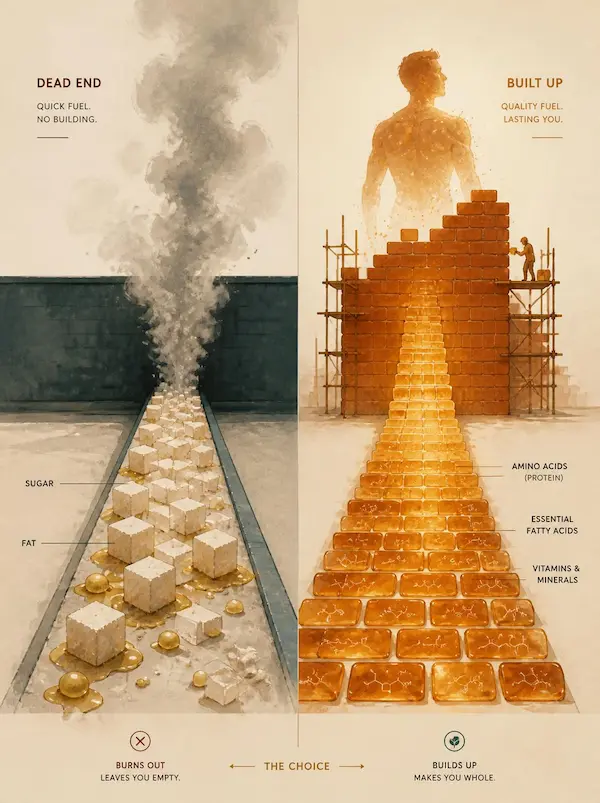
If you’ve read this far and concluded “so sugar and fat are the enemy, I need to eliminate them completely” – stop. You’ve understood half the thesis, and that half, taken to the extreme, makes you sick just as surely as excess does.
I’m not saying sugar and fat are irrelevant. I’m saying their importance is much smaller than that of amino acids – but it still exists, and it’s real. Insulin has a real permissive role: it reduces muscle breakdown, and protein itself already produces an insulin response – you don’t necessarily need separate sugar as a “mandatory trigger.” Even someone predominantly in ketosis can choose, optionally, small glucose spikes as an adjustment variable – not as biochemical law without which nothing works.
The zero extreme is just as wrong as the excess extreme. Both ignore the same lesson: every macronutrient has a precise role, in a precise amount, at a precise moment – not a fixed “good fuel” or “bad fuel” label forever.
This ties directly into the logic of cycles from the article’s opening – the same lesson I learned personally over 30 years without meat, the same lesson I find, as a principle, in Sinclair’s work on partial cellular reprogramming (even though that’s about something else, not nutrition): acceleration AND braking, at the same time, never just one. A body running only on “total restriction” burns just as wrong as one running only on “total excess.” Extremes don’t work. Hierarchy and rhythm work.
What this means, concretely, for your plate: amino acids are the non-negotiable priority, in the quantity and form the body can actually use. Sugar and fat are co-factors and fuel, used with intent – not eliminated out of fear, not abused out of craving, but dosed as part of a system that needs all 3, in the right proportion, not the maximum or minimum amount possible.
“You’re not at war with sugar or fat. You’re negotiating with them. You give what’s needed, when it’s needed, to support the real work – the work done by amino acids. Everything else is just background noise in a debate that’s gone on 50 years too long.”
— BRALGEI SHACKRY
-> On what a ketogenic protocol looks like in practice when it doesn’t fall into the zero-carb extreme trap: “Ketogenic Diet – Fundamentals”.
That’s the whole thesis, start to finish: counting calories isn’t what keeps you healthy. Demonizing one macronutrient doesn’t cure you. The correct hierarchy – fuel used with intent, amino acids treated as the absolute priority – is the only thing that actually matters.
The Complete Protocol: hierarchy + cycles + materials.
Enough theory. You’ve understood the mechanism – now let’s see what you do with it tomorrow morning.
This is the protocol I follow, and the one I’ve tested on myself, for 30 years. It’s not a “universal recipe” – it’s the hierarchy logic I adjust depending on context. But the principles are fixed.
THE BASE PROTOCOL – the 2 essential amino acid thresholds
- Official minimum threshold (FAO/WHO/UNU 2007): bodyweight (kg) x ~39mg leucine/day – the estimated average requirement for basic functions (neurotransmitters, hormones, enzymes)
- The threshold I use in coaching, starting from this official minimum: I consider 66mg/kg a much more suitable minimum threshold in practice – it isn’t an FAO/WHO figure, it’s my own recalibration from over 30 years of experience with clients, for anyone who wants a real functional margin, not just the bare minimum for survival. This threshold climbs toward 99mg/kg for athletes, advanced hypertrophy, and intensive muscle regeneration – all the more so given the anabolic resistance that appears after 50.
- Order matters: the body serves (1) neurotransmitters first, then (2) hormones and enzymes, and only then (3) muscle with whatever’s left. If you don’t hit the minimum threshold, nothing reaches step 3, no matter how hard you train.
The other 2 macronutrients, as support, not as the enemy:
- Carbohydrates: not zero, target somewhere around 5-15% of intake – enough to trigger the small insulin spikes muscle needs as a trigger, without flooding the system (for example, on a 2000 kcal/day diet, that’s roughly 25-75g of carbohydrates)
- Fats: quality sources, non-oxidized, as hormonal precursors and membrane structure – not just filler fuel
The cycle, not permanent restriction:
- A fasting window between meals, to give the microbiome time to process what it’s already received – my own practical observation, not a rule with an exact hour backed by science
- Not a fixed extreme forever – acceleration and braking, in cycles, as a principle similar to partial cellular reprogramming (Sinclair) – even though that’s about something else, not nutrition
- Mild, cyclical restriction – not chronic starvation – to keep the mitochondria sharp, not lazy
Where Thot Aminos and Thot Nutrition comes in
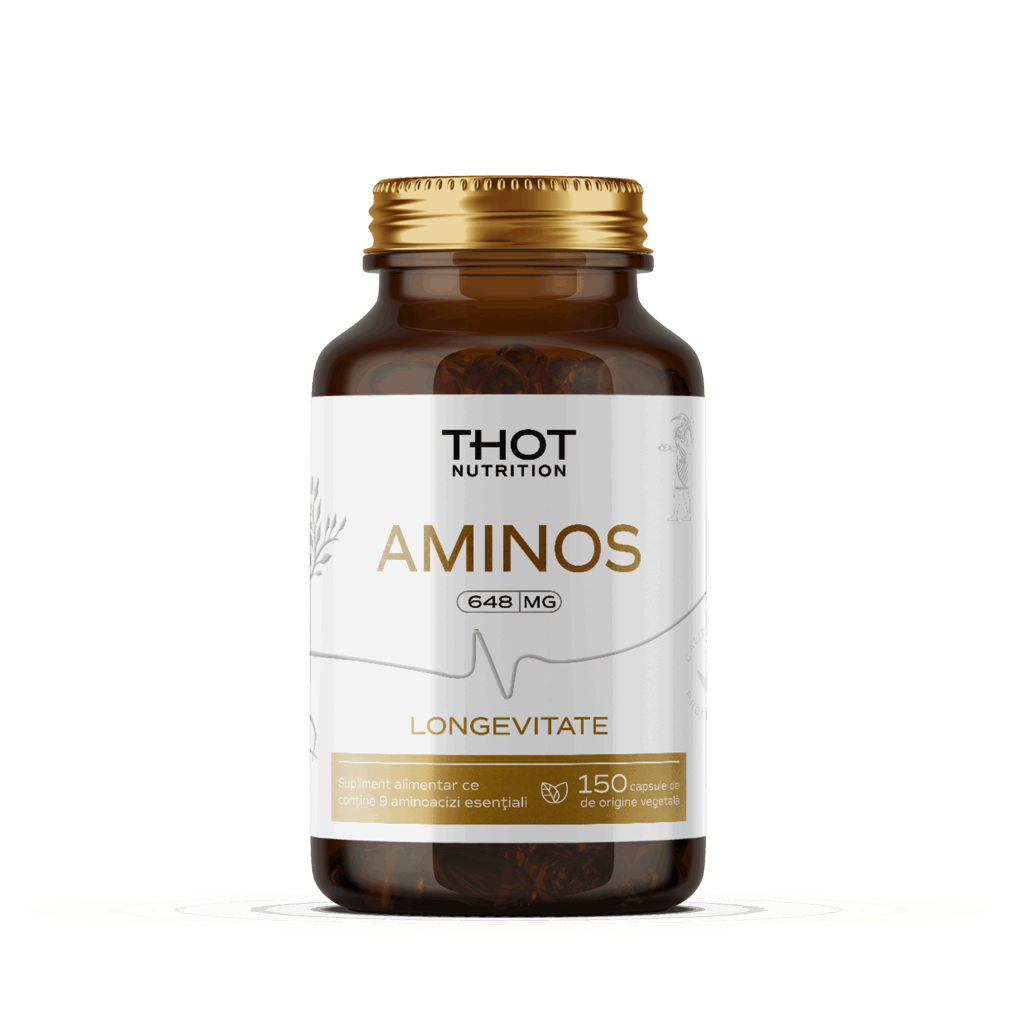
Here’s the real biohack, not the marketing: instead of eating pounds of meat to get your target amount of leucine and lysine – passing through the digestive filter, which varies from person to person, plus the splanchnic filter that retains a portion regardless – you can take the essential amino acids directly, in free, orthomolecular form, processed to nano-molecular size. The real advantage: they skip the digestive filter almost entirely (they don’t need enzymes to be broken down), they reach the bloodstream in 15-20 minutes, with precise and predictable dosing – not dependent on how well you happen to digest that day. Thot Aminos contains all 9 essential amino acids, with 39% leucine – a ratio calculated precisely to consistently push you past the mTOR threshold, regardless of age or the anabolic resistance that appears after 50.
It’s not about replacing food. It’s about no longer depending on the variability of your own digestion – enzymes, age, gut health – for the most important part of your diet, while your body keeps searching, through hunger, for exactly what you’re not giving it.
“I’m not asking you to count calories better. I’m asking you to count something else: the amino acids your body is waiting for, every day, to do the job it was built to do.”
— BRALGEI SHACKRY
-> Full details on the Nano-Molecular Amino Acids in Thot Aminos formula, dosage, and administration protocol: thotnutrition.com/product/thot-aminos-antiaging.
[IMAGE: THOT-AMINOS-150-CAPSULES, product link]
Who this article is for.
For anyone who’s counted calories for years and still doesn’t see the results they deserve. For anyone who’s tried low-carb, then keto, then low-fat, and is tired of that hope-disappointment cycle. For anyone who feels that hunger that never goes away, no matter how “healthy” they eat. And for anyone who, like me, rejects the classic narrative – not out of contrarianism, but because they’ve tested it on their own skin and seen where it runs aground.
I’m not against the classic narrative. It’s just inefficient, and now you know why. I’m speaking to the people who no longer want to cut corners and actually want to optimize their bodies. The idea is the same every time: to live long, but well.
Die young, as late as possible.
How do you do that? By understanding why what happens, happens – and rewriting the narrative.
Frequently Asked Questions.
Is it true that “a calorie is a calorie,” no matter the source?
No. The body spends energy differently to process each macronutrient (the thermic effect of feeding): 11-14% of protein’s calories go just toward processing it, versus 4-8% for carbohydrates and fat. Plus, only amino acids can become structure – sugar and fat always remain fuel, no matter how “healthy” the source.
Why do I overeat even when I’m fasting or on a strict diet?
Your body is very likely searching for a fixed protein target it isn’t reaching (Protein Leverage Hypothesis, Raubenheimer & Simpson). If your diet is diluted in sugar and fat but low in quality protein, your body keeps demanding food until it hits its amino acid target – no matter how many “empty” calories you’ve already eaten.
Do I need to eliminate sugar or fat completely from my diet?
No. The zero extreme is just as dysfunctional as excess. Muscle needs a bit of sugar as a trigger (a small insulin spike), and quality fats are genuine hormonal precursors. Reasonable target: 5-15% of intake from carbohydrates, with amino acids as the priority for the rest.
How much essential amino acid (leucine) do I need per day?
The official minimum requirement (FAO/WHO) is ~39mg/kg/day, for basic functions. From my 30+ years of coaching experience, I recommend a more suitable minimum threshold of 66mg/kg/day, climbing toward 99mg/kg/day for athletes, advanced hypertrophy, or intensive muscle regeneration – especially after 50, when anabolic resistance sets in. For a 75kg adult: official minimum ~3g/day, my coaching threshold 5-7.4g/day.
Why is absorption from meat or eggs lower than from a supplement?
Not necessarily lower – more variable and slower. Digestion of protein from meat/eggs is efficient in a healthy person (86-92%, human studies), but then also passes through the splanchnic filter (gut+liver), which retains 23-50% depending on age – so final availability lands somewhere around 45-70%. Free amino acids skip the digestive filter (they don’t need enzymes), but still pass through the splanchnic filter. Their real advantage: speed and predictability, not some magic “total utilization” figure.
What does intermittent fasting have to do with any of this?
Part of the fermentation and processing work for certain nutrients (fiber, some vitamins) is done by the microbiome, not by you directly. From my own practical observation – not from a study documenting an exact timeline – I believe that if you eat too often, with no break, the microbiome never gets the chance to finish its work cycles. There’s no universal “8-14 hour” threshold established scientifically; it’s a personal hypothesis, not a confirmed fact.
Is it safe to do restriction cycles (vegetarian/vegan for a while, then reintroduce)?
Yes, if you respect the logic of the cycle – not permanent restriction with no compensation. The body needs acceleration AND braking, not just one; a principle similar to the one behind partial cellular reprogramming (3 of 4 Yamanaka factors, not a full wipe) – even though that study was about something else, not nutrition.
What is leptin resistance, and why do I always feel hungry?
Leptin is the signal that tells the brain “you have enough reserves, stop searching.” Chronic inflammation and excess processed fructose block this signal, and the brain believes you’re starving regardless of your actual reserves. The result: constant hunger, unrelated to any real energy need.
Read Next.
Sarcopenia, Osteopenia, Muscle, Bone – bralgei.com
NAD – Marketing versus Real Biology – bralgei.com
Nothing Beats Hunger – bralgei.com / EN
New Muscle Hypertrophy Biohacks with Creatine and Nano-Molecular Leucine – bralgei.com / EN
Ketogenic Diet – Fundamentals – bralgei.com
The Building Blocks of Life and Nutrition – What Are Essential Amino Acids? – thotnutrition.com / EN
L-Leucine – The Key to Muscle Recovery, Health, and Longevity – thotnutrition.com / EN
Thot L-Methionine – The Game-Changer in Bio Regeneration – thotnutrition.com
Thot Leptin Rx – the effective solution for weight loss – thotnutrition.com
Thot Aminos – complete plant-based EAA, 39% leucine – thotnutrition.com
– Bralgei Shackry aka Gabriel Pesa
CONCEPT by Bralgei Shackry | DESIGN & LAYOUT created with Claude by Anthropic